INSIGHTS / FIELD GUIDE
10 min read

Quick answer: UGC stands for user-generated content. It includes reviews, photos, videos, comments, and social posts that customers or community members create. Marketing teams also use “paid UGC” to describe content they commission from independent creators.
Understanding the term is the starting point. Brands also need to decide who should create the content, which customer questions it should answer, and where they will use it.
Unboxings, demonstrations, and personal recommendations are familiar formats. Their value depends on the details: a credible creator, a relevant situation, and a clear explanation of the product.
This guide explains the different types of UGC, their role in marketing, and how to develop a program that improves through testing and audience feedback.
What Is UGC?

User-generated content comes from people sharing their views, experiences, or ideas. In a brand context, common examples include:
Customer ratings and written reviews
Product photos and short videos
Tutorials, demonstrations, and unboxings
Before-and-after content
Testimonials and personal stories
Comments and community discussions
The traditional UGC meaning focuses on content customers create on their own initiative. A traveler posts a hotel review. A skincare customer shares a morning routine. A software user records a tutorial.
These people describe their own experiences without following a brand’s production brief. Their content may be positive, critical, or mixed.
Marketing teams also commission independent creators to produce similar formats. The American Marketing Association’s UGC guide discusses both customer contributions and specialist creators who produce sponsored content.
This broader usage explains why “What’s UGC?” can refer to both spontaneous customer posts and paid creator assets. The distinction matters: commissioned content involves a commercial relationship, agreed deliverables, and permission to use the material.
What Does UGC Mean in Marketing?
UGC presents a product through a customer’s experience or a creator’s demonstration. It can help explain how the product fits into a situation the audience understands.
For example, a luggage video might show what fits inside the case and how its compartments help someone pack. A software tutorial might demonstrate a workflow that reduces manual tasks.
These examples give the audience information they can use to judge the product. Broad claims such as “durable” or “easy to use” become more useful when the content shows what those claims mean.
UGC can support several marketing goals:
Trust: Honest experiences and specific details help people assess a brand.
Relevance: Different creators can address different needs and use cases.
Education: Demonstrations explain features, setup, and everyday use.
Creative testing: Brands can compare openings, messages, and calls to action.
Audience insight: Questions and responses reveal what needs further explanation.
These benefits depend on the quality and truthfulness of the content. A casual filming style alone does not establish credibility.
Organic UGC, Paid UGC, and Influencer Content

These categories describe different relationships between the creator and the brand.
Content Type | Who Creates It? | Main Value for the Brand | Common Publishing Channels |
|---|---|---|---|
Organic UGC | Customers, fans, or community members | Independent experiences and customer feedback | Customer accounts, reviews, and communities |
Paid UGC | Creators hired to produce content | Content assets with agreed usage rights | Brand accounts, ads, websites, and email |
Influencer Content | Creators with an established audience | Content plus access to an audience | Creator accounts and agreed advertising placements |
A paid UGC creator does not necessarily need a large following. A brand may hire them for their communication skills, filming ability, or fit with a customer profile.
Influencer marketing usually places greater weight on the creator’s audience and public reputation. The brand wants the content to reach people who already follow or engage with that creator.
A campaign can combine both models. A creator might deliver videos for a brand’s website, publish a separate post, and authorize advertising use.
Meta’s creator marketplace guidance describes how brands and creators can arrange collaborations and use partnership ads to promote creator content.
Before hiring, clarify whether the agreement covers production, publishing, advertising rights, or all three.
How Brands Should Approach UGC in 2026
Reviews, routines, and demonstrations remain useful formats. Brands can get more value from them by improving the decisions behind production and distribution.

Make Credibility Specific
Vertical video, handheld footage, and casual settings can suit social platforms. They do not explain why someone should believe the message.
Credibility comes from relevant details. What did the person use? In what situation? What worked well, and what limitations should a buyer understand?
Authenticity means the content accurately reflects the person’s experience and relationship with the brand. A paid creator can communicate honestly, but the content should not present a scripted experience as an independent customer review.
Test Meaningful Creative Variations
One creator and one script provide limited evidence. If a video performs poorly, the team may struggle to identify the cause.
Plan variations around clear questions. Does an opening about the customer’s problem hold attention better than a product demonstration? Does answering a common objection improve qualified clicks?
Where practical, change one major element at a time. If the creator, offer, script, and audience all change together, the results become harder to interpret.
A useful brief defines the audience, product facts, required points, and creative boundaries. Give creators room to express those points in language they would naturally use.
Adapt the Story to the Market
Localization means adapting content to a market’s language and context. Translation is one part of that work.
A script may be grammatically correct while using unfamiliar examples or an unsuitable tone. Review:
Local expressions and speaking style
Customer concerns and buying habits
Familiar settings and product uses
The creator’s fit with the intended audience
Platform expectations in that market
Local creators can help identify details that a translated brief misses. Their input should shape the story before filming.
Use AI With Editorial Judgment
AI tools can assist with ideas, draft scripts, subtitles, editing, and translation. Teams still need to check product facts, natural language, and cultural fit.
A translated line may sound awkward. An edited demonstration may leave out an important step. A generated claim may exceed what the product can support.
Review these details before publishing. More versions are useful when they test worthwhile ideas and remain accurate.
Plan for Multiple Channels
A creator video may serve as a social post, paid ad, product demonstration, or email asset. Each placement has different needs.
A social opening may need to establish relevance quickly. A product-page video may need a fuller explanation. An advertising version may require a different call to action.
Define the intended placements before production. Agree on the necessary formats, edits, and usage rights so the team can reuse suitable content efficiently.
Why UGC Campaigns Fail
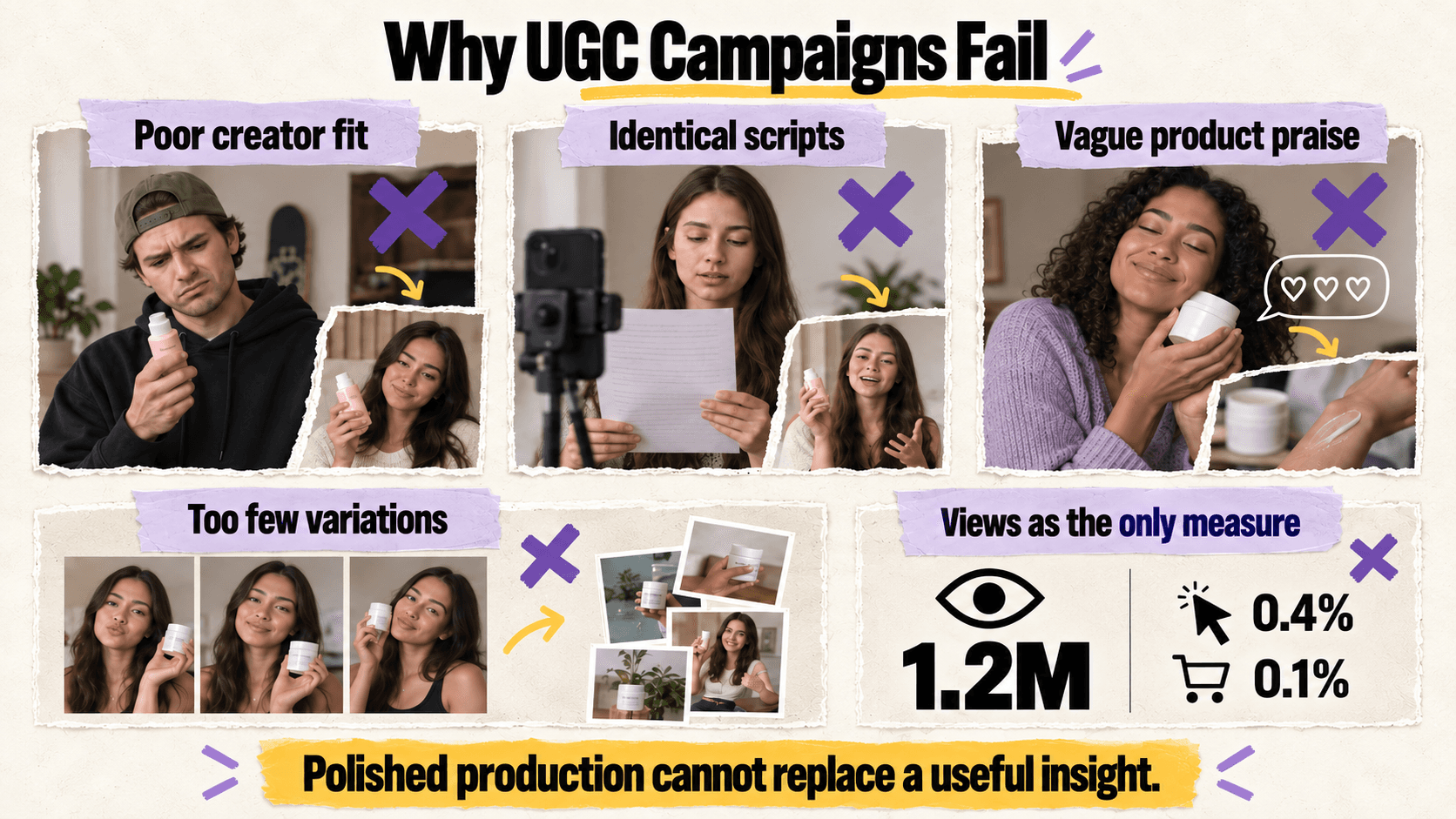
Several common problems can weaken a campaign even when the production looks professional.
Common Problem | Why It Matters | Practical Adjustment |
|---|---|---|
Poor creator fit | The audience struggles to relate to the message | Match creators to customer needs and use cases |
Identical scripts | Delivery sounds repetitive or forced | Keep approved facts while allowing natural wording |
Vague product praise | Viewers learn little about the product | Show a specific benefit, limitation, or demonstration |
Too few variations | Results offer limited guidance | Test distinct ideas with enough data to compare |
Views as the only measure | Exposure can hide weak interest or action | Match performance measures to the campaign goal |
A useful distinction is between a format and an insight. An unboxing is a format. A concern about difficult setup is an insight that can guide what the unboxing explains.
The brief should identify that underlying question. Otherwise, the team may produce polished content that leaves the buyer’s main concern unanswered.
How to Build an Effective UGC Strategy
A repeatable program connects audience research, creator selection, production, distribution, and review.
Step 1: Define the Audience and Objective
Choose the customer group, market, and problem the content should address.
Set a clear objective, such as explaining setup, improving product understanding, testing a new message, or supporting qualified purchases. Different objectives require different creative choices and measures.
Step 2: Match Creators to the Brief
Review how each creator speaks, demonstrates products, and relates to the intended audience.
Relevant experience may matter more than polished delivery. For example, a creator familiar with team software may explain approval workflows more clearly than someone reading a feature list for the first time.
Step 3: Plan the Content and Usage Rights
Specify the deliverables, key facts, filming requirements, and review process. Agree on where and how long the brand can use the content, including any paid advertising or editing permissions.
Obtain permission before reusing customer content. A public post does not automatically give a brand unrestricted rights to use it in marketing.
Step 4: Review Claims and Disclosures
Check that demonstrations and personal statements accurately reflect the product and the creator’s experience.
The FTC’s guidance on endorsements, influencers, and reviews explains when creators should disclose material connections to a brand. These can include payments, free products, or other benefits that could affect how an audience interprets an endorsement.
For US campaigns, include disclosure and claim review in the approval process.
Step 5: Publish, Measure, and Improve
Distribute each version through the agreed channels. Record the creator, message, audience, and placement so the team can compare results.
Use each asset to test a clear idea. Review the evidence before deciding what to repeat, change, or stop.
How to Measure UGC Performance
Views help describe exposure, but they cannot explain the full value of a campaign.
Choose measures that reflect the objective:
Objective | Useful Measures | What to Review |
|---|---|---|
Capture attention | Early retention and watch time | Whether the opening earns continued viewing |
Explain the product | Completion, saves, and relevant questions | Whether viewers understand the demonstration |
Generate interest | Click-through rate and qualified visits | Whether the message attracts suitable prospects |
Support conversion | Purchases, leads, and cost per qualified action | Whether the content supports the intended outcome |
Improve future content | Results by creator, message, and market | Which ideas deserve another test |
Use the same definitions when comparing results. Platforms may calculate views, retention, and engagement differently.
Distribution also affects performance. Different budgets, audiences, offers, or placements can change the outcome even when the creative remains the same.
Compare UGC with your existing content under similar conditions where possible. Treat changes in search interest or brand discussion as supporting signals, since other marketing activity may also influence them.
A Practical Multi-Market Example
Consider a hypothetical skincare brand preparing content for the United States, Germany, and Saudi Arabia.
The team could begin by reviewing customer questions in each market. It might then test ingredient explanations, morning-routine demonstrations, and questions about use in different climates.
These are possible creative angles, not assumptions about what every customer in a country prefers.
Local creators would adapt the examples, wording, and setting. The brand would keep product facts consistent and compare results by market, creator, and message.
If a demonstration performs well in one market, the team can test the underlying idea elsewhere. It should still check whether the local audience shares the same concern.
This approach gives the brand evidence for its next production round while allowing each market to retain its own context.
How PIDRR Supports UGC Production and Distribution

PIDRR’s UGC creator video production covers creator matching, filming, editing, and delivery. Brands can provide their target country, language, video style, and key product information.
Creator and Market Fit
Creator selection considers the product, audience, and intended style. The brief can focus on demonstrations, unboxings, everyday use, or feature walkthroughs.
Country and language options help teams develop content for specific markets.
Clear Production Planning
Define the audience, required product facts, and intended placements before filming. Agree on creative variations, deliverables, usage permissions, and review expectations as part of the project scope.
This gives both the brand and creator a clearer basis for production.
Publishing and Ongoing Review
PIDRR’s social media management service supports planning, scheduling, publishing, and ongoing optimization across social platforms.
When combining production with publishing, agree on reporting needs at the start. Delivery records show what the team produced and posted; audience and conversion data help assess what happened afterward.
Is UGC Still Worth It in 2026?
UGC can remain useful when it answers customer questions, demonstrates the product clearly, or provides credible experiences that other content does not capture.
Its value depends on creator fit, the offer, production quality, distribution, and measurement. A brand should assess these factors against its own campaign goals.
A program does not need endless variations. It needs enough useful tests to reveal which messages work and which questions remain unanswered.
Budget decisions should reflect those findings, rather than assuming that every creator video will outperform other advertising.
Frequently Asked Questions

What Does UGC Stand For?
UGC stands for user-generated content. It traditionally refers to material that customers or community members create, such as reviews, photos, videos, and discussions.
What’s UGC in Social Media Marketing?
UGC presents experiences or ideas from a user’s perspective. Brands may share customer posts with permission or commission creators to produce content for social channels and advertising.
What Does UGC Mean for Brands?
UGC can support product education, social proof, creative testing, and audience research. Its role depends on the campaign goal and whether the content comes from customers or paid creators.
Do UGC Creators Need a Large Following?
No. When the main deliverable is content for brand channels, filming ability, communication skills, and audience fit may matter more. Follower reach becomes relevant when creator publishing forms part of the agreement.
Is Paid UGC the Same as Organic UGC?
No. Paid UGC describes commissioned creator content. Organic UGC comes from customers or community members without that production arrangement. Brands should make relevant commercial relationships clear.
How Does UGC Differ From Influencer Marketing?
Paid UGC campaigns often focus on acquiring content assets. Influencer campaigns also seek access to a creator’s audience. One partnership can include both production and audience distribution.
How Can Brands Scale UGC Internationally?
Work with suitable local creators, adapt stories to each market, and keep product facts consistent. Plan usage rights and distribution, then use results to guide the next round of content.
Build a UGC Program That Improves With Each Campaign

UGC gives brands a way to explain products through customer experiences and creator perspectives. A structured program connects those perspectives with clear briefs, suitable placements, and measurable goals.
If your team needs support with creator matching, production, or social publishing, contact PIDRR to discuss your product, target market, and content needs.
NEED A PARTNER?
Talk with the PIDRR team about your next social strategy, content system or campaign.
Contact Our Team