INSIGHTS / FIELD GUIDE
6 min read

Search behavior is changing.
A user can search for a question today and receive an AI-generated answer before clicking any website.
For businesses, this creates a new challenge:
Ranking is no longer the only goal. Businesses must also create content that search systems can understand, trust, and select as an answer.
Google’s official guide to AI features in Search explains AI Overviews and AI Mode. Both features can show direct answers and links beside traditional search results. As AI-powered search grows, more users may find information without an initial click.
The central question is whether AEO will replace SEO.
AEO does not replace SEO. It builds on the foundation SEO provides.
Traditional SEO helps search engines discover, understand, and rank content.
Answer Engine Optimization adds another goal. It makes the most useful information on a page easier to identify and use as an answer.
A concise way to frame the difference is:
SEO improves search visibility. AEO helps content become the answer.
Quick Answer: AEO vs SEO
SEO, or Search Engine Optimization, focuses primarily on improving visibility in traditional search results.
AEO, or Answer Engine Optimization, focuses on making information easier for answer systems to understand, extract, and present directly.
SEO | AEO | |
Main Goal | Improve search visibility | Surface useful answers |
Typical Result | Rankings, impressions, and clicks | Direct-answer visibility |
Main Focus | Relevance, authority, search intent | Clear, structured information |
Measurement | Rankings, traffic, clicks | Answer visibility, mentions, citations |
Common Environment | Google and Bing search results | Featured answers and AI-assisted search |
Simple Definition | Get found | Become the answer |
AEO supports answer-focused search. SEO foundations still matter.
What Is SEO?
SEO helps search engines discover, understand, evaluate, and rank webpages.
It includes technical SEO, search intent, keyword research, content quality, internal linking, backlinks, site structure, and topical authority. These foundational practices help search engines crawl, index, and understand web content.
Effective SEO goes beyond keyword repetition. It connects useful content with people who need it.
If someone searches “digital marketing companies,” for example, SEO helps relevant pages compete for visibility in those search results.
These foundations still matter as search becomes more answer-driven.
What Is Answer Engine Optimization?
AEO stands for Answer Engine Optimization.
It focuses on making useful information easier to identify and present as a direct answer. Marketers use AEO for efforts that improve visibility in AI search experiences. These efforts remain grounded in SEO fundamentals and can support AI-generated answers as well as traditional search results.
Imagine someone searches:
“What is a digital marketing company?”
One article delays the definition until paragraph six.
AEO favors a direct answer. A short definition could say, “A digital marketing company helps businesses grow.” Then list the main channels, such as SEO, paid advertising, social media, and content marketing.
The longest article does not always perform best. More keywords do not guarantee better results. Clear, useful, and trustworthy answers often perform better.
AEO-friendly content often includes:
Clear definitions
Direct answers
Descriptive headings
Short, focused paragraphs
Comparison tables
FAQs
Credible supporting evidence
Original information or insight
AEO does not require shorter articles. It requires clear structure and easy access to important information.
Why AEO Will Not Replace SEO
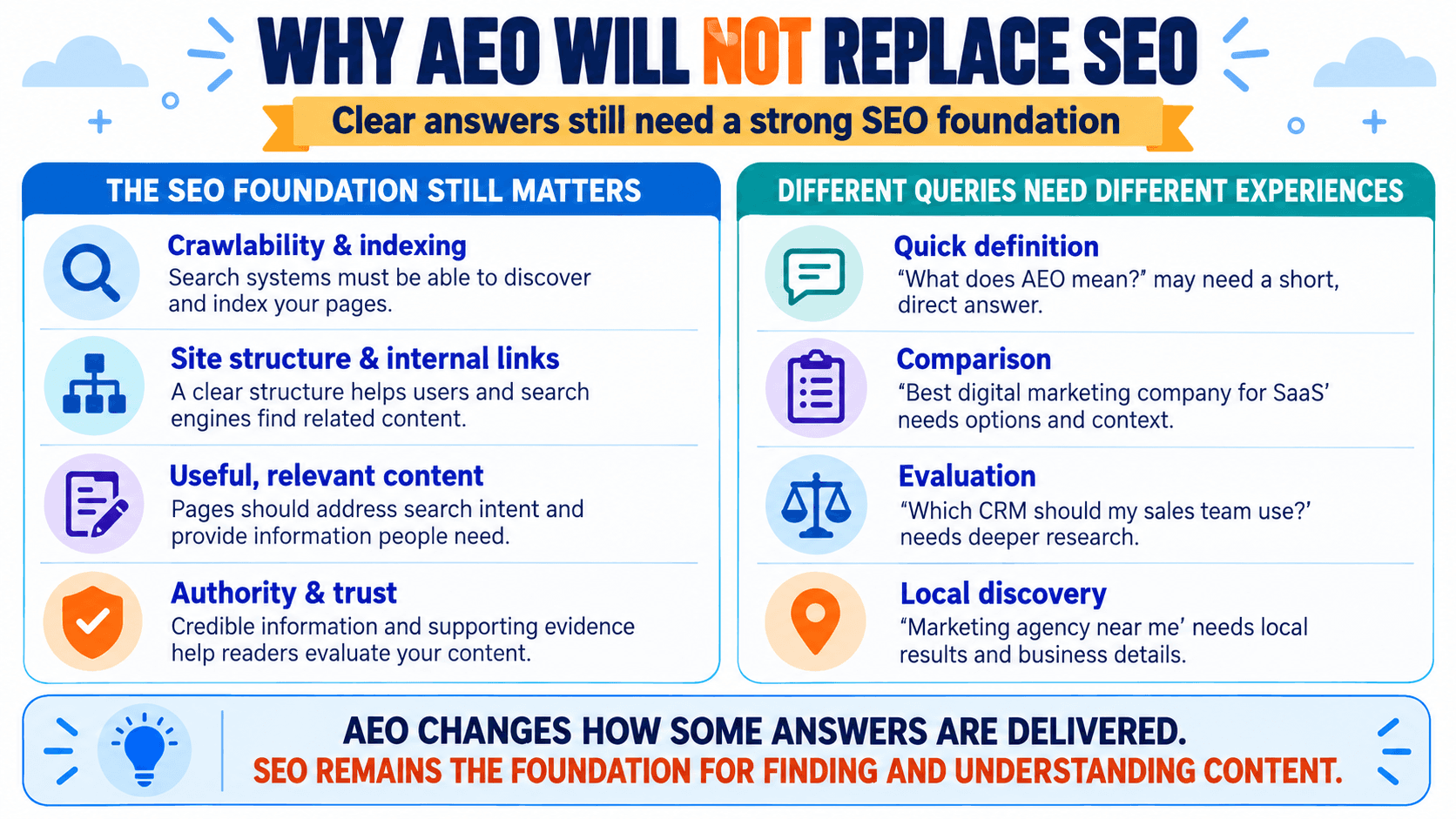
Google also states that existing SEO fundamentals remain relevant for AI Overviews and AI Mode.
Google can consider a page for supporting links only after its systems crawl and index it. The page must also be eligible to appear in Google Search.
This means clear site structure, internal links, useful content, authority, and easy crawling still matter.
SEO also remains important because:
A single direct answer cannot satisfy every search query.
A question such as “What does AEO mean?” may require only a short explanation.
“Best digital marketing company for SaaS” requires comparison.
“Which CRM should my sales team use?” requires evaluation.
“Marketing agency near me” may require local results and business information.
AEO changes how platforms deliver some information, but traditional search still matters.
What Does AEO Add to Traditional SEO?
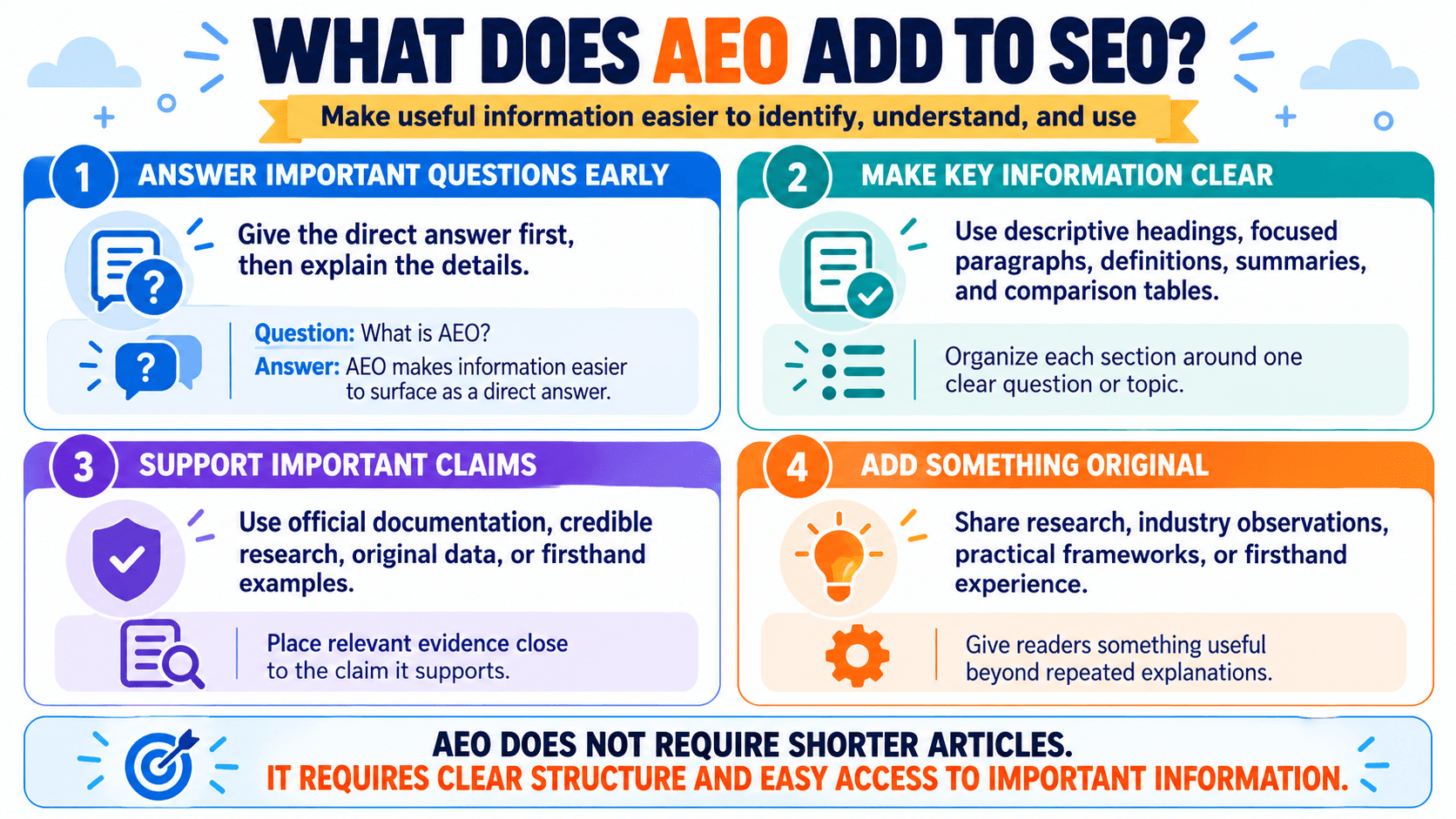
Businesses already investing in SEO do not need to rebuild everything. The main change is the clarity of the information they present.
Answer Important Questions Earlier
If a section asks “What is AEO?”, answer the question first and explain the details afterward.
Make Key Information Easy to Understand
Definitions, summaries, comparison tables, structured data, and clearly labeled sections help users and answer systems understand a page faster.
Support Important Claims
Use official documentation, credible research, original data, or firsthand examples where they add value.
A page that makes strong claims without evidence is less useful to readers and harder to trust.
Add Something Original
If twenty pages repeat the same explanation, creating the twenty-first version adds little value.
Original research, industry observations, frameworks, examples, and firsthand experience make content more useful and more difficult to replace.
Google AI Overviews Are Already Changing Click Behavior
A Pew Research Center study examined 68,879 Google searches. Users clicked a traditional search result in about 8% of visits when an AI summary appeared. The rate was about 15% when no AI summary appeared.
Users clicked links inside the AI summary in only about 1% of visits.
Users still need websites for deeper information, comparisons, and action. Websites must earn visibility in a more competitive answer environment.
Marketers should ask two questions.
“Can this page rank?”
“Can search systems use this page as a clear answer?”
These questions guide the content strategy.
Where Does GEO Fit In?
As AI search evolves, marketers increasingly discuss Generative Engine Optimization, or GEO.
AEO and GEO overlap, but their focus is different.
AEO: Make content easier to surface as a direct answer.
GEO: Improve visibility inside generative AI responses.
Original Generative Engine Optimization research from Princeton University examined methods for improving visibility in generative-engine responses. Some methods improved visibility by up to 40% in certain cases. Results varied across domains.
GEO matters in generative AI environments such as ChatGPT, Gemini, and Perplexity.
A simple framework:
SEO = Get found
AEO = Become the answer
GEO = Gain visibility in generative AI
Industry experts still use these terms differently. Their boundaries are not always consistent.
A Simple SEO, AEO and GEO Example

Consider a digital marketing agency. It publishes an article about what a digital marketing company does.
SEO helps that article rank in traditional search. AEO makes the definition easy to surface as a direct answer. GEO creates another opportunity for the agency to appear in generative AI responses.
One clear content source can support all three approaches across different search experiences.
6-Point AEO Content Audit Checklist

Before publishing or updating a page, check these six things:
☐ Answer the main question early.
☐ Make the main answer clear without additional context.
☐ Use clear, descriptive headings that are easy to follow.
☐ Support important claims with credible sources or evidence.
☐ Add original insights, examples, or experience.
☐ Identify who created the content and explain why readers should trust the source.
These practices make information clearer and more useful for users and search platforms. Marketers should not create content solely to satisfy AI systems.
AEO and SEO work best together because both approaches improve how users and search platforms access useful information.
Is AEO the New SEO?
AEO is not a replacement for SEO.
AEO reflects a change in how people receive information from search. Traditional SEO grew around ranked links. AEO responds to platforms that increasingly answer some questions before a click happens. The SEO foundation remains important.
Businesses that focus only on rankings may miss new answer-driven visibility opportunities.
Businesses that drop SEO may weaken the technical and content foundation that answer systems still rely on.
The stronger strategy combines both approaches.
Frequently Asked Questions
What is the main difference between AEO and SEO?
SEO focuses primarily on search visibility and rankings.
AEO focuses on making information easier for answer systems to understand and surface directly.
Does AEO replace SEO?
AEO works alongside SEO. Useful content, technical site health, internal linking, and authority still matter.
How do I optimize content for AEO?
Start by answering important questions early, structuring content clearly, supporting claims with evidence, and adding original insights that provide value beyond existing information.
Is AEO only about AI?
No. AEO can apply to different answer-focused search experiences. Generative AI visibility is more specifically associated with concepts such as GEO.
What is the difference between AEO and GEO?
AEO focuses on answer visibility.
GEO focuses more specifically on visibility, mentions, or citations inside generative AI responses.
Final Thoughts
Search platforms are delivering more answers directly, but SEO is not disappearing.
AEO adds another opportunity: making useful information easier to understand and surface before a user clicks.
GEO extends that visibility into generative AI environments.
Businesses do not need to choose between SEO and AEO.
Businesses need content that people can find and trust. Clear answers can earn visibility in both search and AI systems.
SEO improves search visibility. AEO helps content become the answer.
Need help adapting your content strategy for AI-driven search?
PIDRR helps brands improve visibility through SEO, content strategy, and global digital marketing solutions.
Connect with our team to explore how your content can perform across traditional search and AI-powered discovery.
NEED A PARTNER?
Talk with the PIDRR team about your next social strategy, content system or campaign.
Contact Our Team